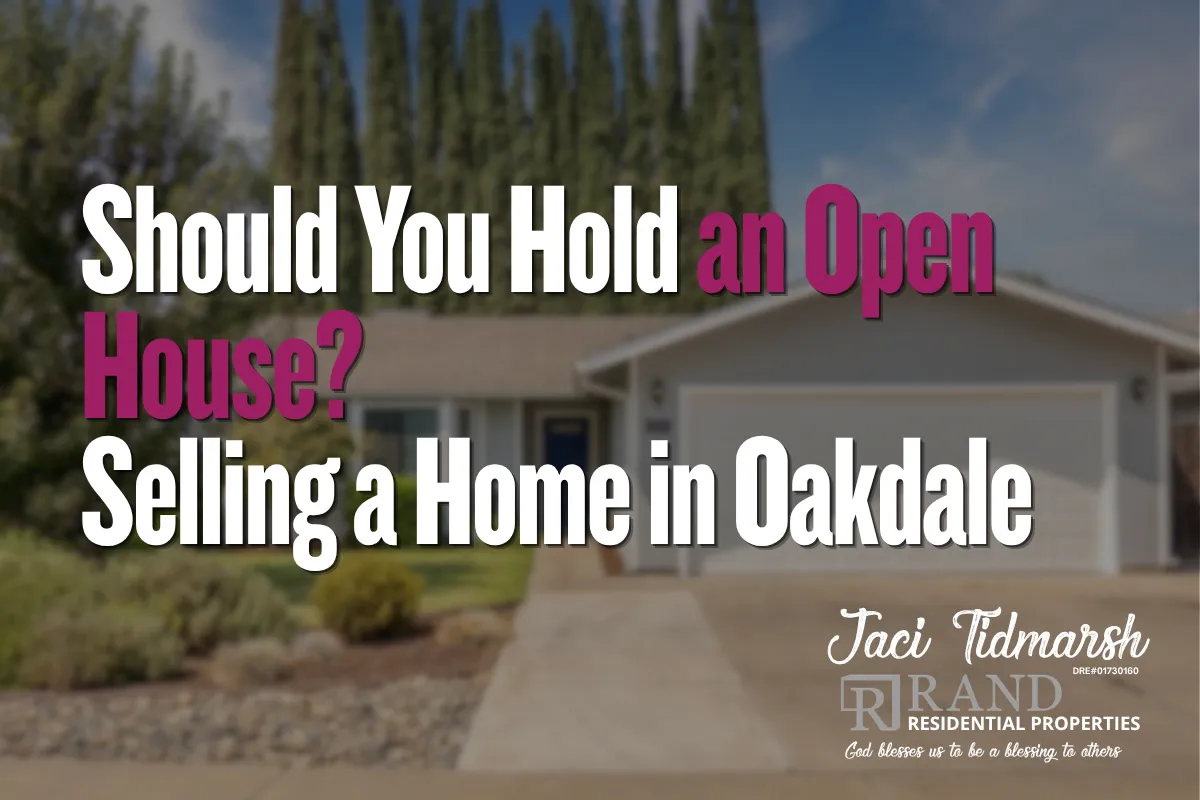
Should You Hold an Open House When Selling in Oakdale?
If you are selling in Oakdale, someone has probably already asked you whether you will hold an open house. It sounds like a simple yes or no question. In my experience it is really a bigger question about how your home will be shown to the people who might buy it.
I've been helping people buy and sell homes in the 209 since 2006. Here is how I look at it. An open house is a tool. It is not the whole strategy. Whether it helps depends on your home, your goals, and what else is happening in your marketing plan.
I do not promise a result from any single tactic, and I'd be wary of anyone who does. What I can do is help you understand what an open house does, what it does not do, and how to decide. Let's walk through it step by step.
What Is an Open House Supposed to Do?
An open house lets people see your home without making an appointment. A set window of time is announced, the door is open, and visitors can walk through at their own pace. For some buyers, that is a low pressure way to take a first look. They can see the layout, get a feel for the rooms, and decide whether the home deserves a second visit.
That ease is the main benefit. It gives more people a chance to see the home at the same time. It also gives buyers who are still deciding what they want a place to look around without feeling committed.
It is worth being clear about what it is not. An open house is not a sale. It is one way to put the home in front of people. What happens after the visit depends on the home, the price, the presentation, and the buyer who walks in.
For the seller, there is a second benefit. You get to see how people respond to the home in a real setting. If visitors keep pausing at the same room or asking the same question, that tells you something. Used well, an open house can teach you as much as it shows.
Is an Open House the Whole Strategy?
No, and I'd be careful if someone treats it that way. A listing needs a plan that runs from before the home goes on the market to the day it closes. An open house is a single event inside that plan.
When I think about a listing, I ask what happens before the open house, what happens after it, and what happens through the rest of the listing period. If the answer to all three is "nothing much," then the open house is carrying too much weight. A strong plan has many parts that work together, and the event is only one of them.
My article on how modern marketing sells homes goes deeper into the bigger picture. It shows how presentation, photos, and reach work together. That is the foundation, and an open house sits on top of it.
What Should Happen Before, During, and After?
Before an open house, the home should be ready and the word should be out. People need to know it is happening, where it is, and when. The home should already look good in its online presentation, because many buyers see the listing first and decide whether to visit based on that.
During the open house, the goal is a relaxed and welcoming visit. Visitors should be able to move through the home easily. Someone should be there to greet people and answer questions, and that someone is usually your Realtor. You do not need to be there, and in most cases it is better if you are not.
After the open house, there is follow up. Which visitors showed real interest? What did people say about the home? That feedback can be useful, and it can guide the rest of the listing period. An open house with no follow up is a missed opportunity.
Timing matters too. A single afternoon is a small window. If the open house falls on a day when the weather is poor or when other plans compete for attention, fewer people may come. That does not mean the home is a problem. It means one event should never carry the whole listing.
What Can an Open House Not Do Alone?
An open house cannot fix a home that is not ready. If the presentation is weak or the home needs attention, a crowd will not change that. It also cannot replace a clear plan for price and marketing.
It cannot guarantee that the right buyer will walk through the door on that day. Some buyers prefer a private showing. Some are busy during the open house window. Some are not looking yet. That is why I never treat it as the only path.
My article on what your home is really worth goes deeper into pricing, which matters more than most sellers expect. No event will make up for a plan that starts in the wrong place. Get the price and the presentation right first, and then decide how the open house fits.
How Do You Get the Home Ready?
Preparation is where an open house is won or lost. Clean the home thoroughly. Clear the counters, tidy the closets, and remove extra furniture that makes rooms feel crowded. Let in as much light as you can. Buyers are looking at the space, so you want the space to be easy to see.
Staging helps here. Staging is about showing the home so a buyer can picture how it works. It does not have to be expensive or complicated. Often it is a matter of simplifying and arranging what you already own so each room has a clear purpose.
My article on staging basics for sellers goes deeper into simple steps that make a difference. You can do much of it yourself, and I'm happy to give you a plain walkthrough of the rooms that matter most before anyone visits.
Walk through the home the way a visitor would before the day arrives. Open the cabinets in your mind, check the drawers that sit in plain view, and look at what is on display. Anything that makes you feel uneasy should be moved. It is much easier to decide this ahead of time than while people are already at the door.
What About Your Privacy and Your Belongings?
This is a real concern, and it should be. An open house means strangers will be walking through your home. Most visitors are simply curious buyers, but you still want to prepare thoughtfully.
Put away anything valuable or personal. That includes jewelry, cash, small electronics, medications, and keepsakes. Put away papers too, such as mail, bills, and anything with account details or personal information. Lock up or remove anything you would not want handled.
Think about the practical side as well. Plan where pets will be during the visit, and arrange for them to be out of the home. Think about whether you are comfortable with photos being taken inside. Your Realtor should help you plan all of this so you feel at ease. If the idea of an open house makes you uncomfortable, that is a good reason to consider the alternatives.
What Are the Alternatives and Add Ons?
There are other ways to show a home, and many sellers use them alone or with an open house. Private showings let a serious buyer see the home at a time that suits them, with your Realtor present. They are more controlled, and they give each visitor more attention.
A strong online presentation matters just as much. Clear photos, a well written description, and good information help buyers decide whether to visit at all. Targeted marketing puts the home in front of people who may be looking for something like it.
You can also combine these. Some sellers hold an open house along with private showings and a strong online push. Others skip the open house and rely on the other tools. My article on the biggest mistakes sellers make goes deeper into the missteps that cost sellers the most, and it can help you avoid them.
Your own comfort counts as much as any tactic. If you are busy, if you are living in the home, or if you have pets and a full schedule, a different approach may fit better. There is no award for doing every tactic. The best plan is the one that serves your goals and that you can carry out without stress.
How Do You Decide for Your Home?
The decision depends on the home and on your goals. Ask what you want from the listing period. Think about how comfortable you are with visitors. Consider the condition of the home and how it shows. Then ask your Realtor how an open house would fit into the plan for your particular home.
A good Realtor will walk you through the pros and cons instead of pushing a single answer. If someone tells you an open house is always required or never worth it, ask them to explain why. The right answer for one home may not be the right answer for another.
My article on five questions every seller should ask before hiring a Realtor goes deeper into how to evaluate the person helping you. Asking about the marketing plan, including whether and how an open house fits, is a good place to begin.
So, Should You Hold an Open House When Selling in Oakdale?
Maybe, and it depends. An open house can let people see your home without an appointment, and that can be useful. It cannot do the job alone, and it works best as one part of a larger plan. Think about what happens before it, after it, and through the rest of the listing period, and choose what fits your home and your goals.
If you are selling in Oakdale, I'd be glad to help you decide. I work across Modesto, Stanislaus County, and the greater 209, and I will explain your options plainly. There is no pressure and no rush.
If you are not sure where to begin, start with a conversation. We can talk about your home, your goals, and what a good plan could look like.
Related Articles
- How Modern Marketing Sells Homes shows how presentation and reach work together on a listing.
- Why Staging Matters When You Sell Your Home explains how to show your home so buyers can picture living there.
- Why My Modesto Listings Often Sell for More Than the Z Estimate looks at what automated estimates can miss.
- What Should I Fix Before Selling My House in Modesto? helps you decide which repairs are worth your time.
- How to Choose the Right Realtor in Stanislaus County shares what to ask before you decide who to work with.
Book a Discovery Call
Jaci Tidmarsh
Rand Residential
DRE #01730160
209-204-3509
[email protected]
209moves.com